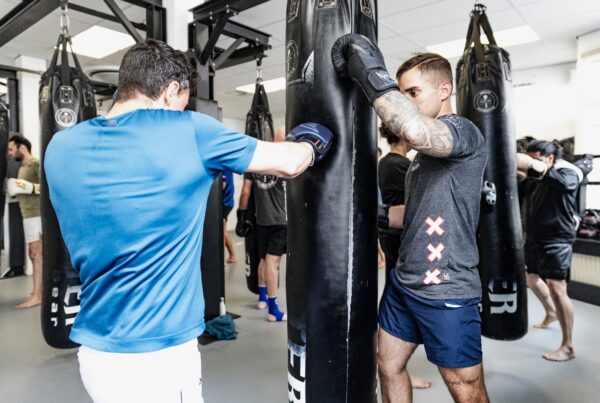
About to start kickboxing but wondering what you actually need to learn? You’re not alone. Many beginners think kickboxing is about hitting and kicking as hard as possible, but nothing could be further from the truth. Kickboxing is technique. And once you get the hang of that technique, every training session becomes more fun, safer and more effective. In this blog we calmly explain the most important kickboxing techniques for beginners, with a nod to the famous Dutch style we grew up with here in Amsterdam.
Why technique matters more than strength
From the outside kickboxing might look rough, but it’s actually a subtle sport. Good technique lets you generate more power with less effort, spend your energy wisely and prevent injuries. A correctly executed punch or kick doesn’t come from your arm or leg alone, but from your whole body: hips, core, feet and timing all work together.
For beginners that’s good news. You don’t have to be a powerhouse to learn kickboxing. Everyone starts with the basics, and it’s precisely those basics that determine how fast you progress. Lay the foundations well and you’ll build on them for years.
The basic stance: your foundation
Everything starts with your stance. Without a good posture you’re literally standing weak.
- Place your feet slightly wider than shoulder-width, with your strong leg back.
- Bend your knees slightly and keep your weight on the balls of your feet.
- Hands up, elbows in, chin down.
- Stay relaxed and mobile, not stiff.
From this stance you can attack, defend and move. Remember: you always return to your basic stance. That’s your home base in the ring.
The most important punching techniques
Hand techniques are the core of every combination. The four basic punches you learn as a beginner are:
- The jab – a fast, straight punch with your lead hand. Ideal for gauging distance and keeping your opponent busy.
- The cross – a powerful straight punch with your rear hand, turning your hip into it.
- The hook – a rounded punch to the side of the head or body.
- The uppercut – a punch from below upward, perfect at close range.
As a beginner you practise these punches separately first, then in short combinations such as the classic “one-two” (jab-cross).
The most important kicking techniques
What sets kickboxing apart from boxing is, of course, the kicks. You learn these step by step:
- The low kick – a kick to the thigh, and the hallmark of the Dutch style.
- The mid kick – a kick to the ribs or midriff.
- The teep (front kick) – a straight push kick to create distance.
- The knee – powerful at close range, especially in the clinch.
The high kick to the head usually comes later, once your flexibility and technique have grown enough. Don’t force anything: your body needs time to become supple and strong.
What makes the Dutch style so special?
The Dutch style of kickboxing is known worldwide for its flowing combinations of hands and legs, a high pace and constant pressure on your opponent. Where some styles emphasise isolated techniques, Dutch style is all about rhythm: punches and kicks flow seamlessly into one another, often finished with a low kick. It’s precisely those combinations that make it so much fun to train — and that build a killer condition.
Common beginner mistakes
Recognise yourself in any of these? You’re in good company. You see these mistakes in almost everyone who starts:
- Dropping your hands after a punch.
- Forgetting to breathe out with each technique.
- Trying to put in too much power and losing your balance.
- Holding your breath and moving too tensely.
The solution? Practise calmly, repeat and trust your trainer. You refine technique with thousands of repetitions, not with brute force.
What can Spallys do for you?
At Spallys in Amsterdam East it’s all about that combination of old-school technique and new-school energy. In our group classes, technique classes and heavy-bag training you learn authentic Dutch style step by step, in an accessible and motivating atmosphere. Our trainers look at your level and help you make every punch and kick just a little sharper.
Want to progress faster or get personal attention? Then personal training is perfect: working one-on-one on your technique, pace and goals. Whether you’re a total beginner or want to sharpen your basics, you’ll feel at home with us quickly. Learning to kickbox in Amsterdam is approachable, sporty and, above all, simply fun at Spallys.
Conclusion
You won’t master kickboxing techniques in a single lesson, but the basics are accessible to everyone. With a good stance, a handful of punches and kicks and the signature Dutch-style combinations, you build a foundation you’ll enjoy for years. Most important of all: just start. Technique comes with repetition, patience and good guidance.
Curious? Come by for a free trial class at Spallys in Amsterdam East and experience for yourself how much fun it is to get the first kickboxing techniques under your belt. We’d love to see you on the mat!