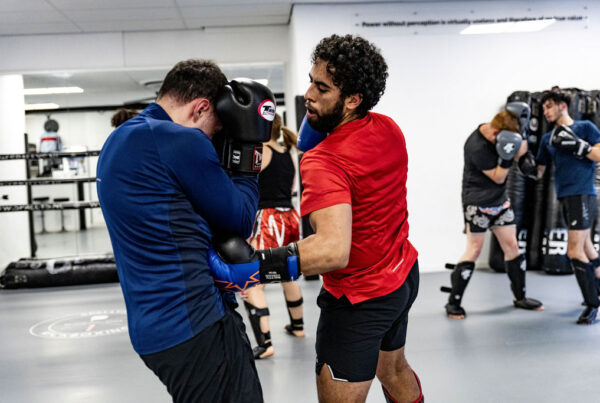
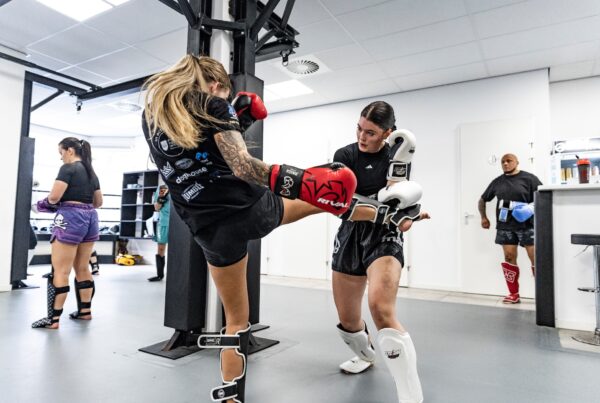
Muay Thai, kickboxing and boxing are three different combat sports. Boxing uses only the fists. Muay Thai uses fists, feet, knees and elbows, plus the clinch. Kickboxing sits in between: punches and kicks, but no elbows and hardly any clinching. Which one fits you depends on what you want to get out of training.
Maybe you want to get fitter, stronger or simply blow off some steam after work. But when you look at a gym schedule, it can be confusing. Boxing, kickboxing, Thai boxing… isn’t that all the same thing? It is not. The goal is the same in all three: hit without getting hit. The rules, techniques and training styles are completely different. At Spallys in Amsterdam East we teach Dutch style kickboxing. Below we explain the differences, so you can choose the right sport.
Muay Thai vs Kickboxing: The Key Differences
The biggest difference between Muay Thai and kickboxing is what you are allowed to use. In Muay Thai you fight with eight “weapons”: fists, feet, knees and elbows. In kickboxing you use four: fists and feet, with knees allowed but less dominant. Muay Thai also has the clinch, where you hold your opponent around the neck. In kickboxing the referee breaks up the clinch. That is why kickboxing has a higher pace with more combinations, while Muay Thai is slower with harder single strikes.
You will also see the term Thai kickboxing or Thai boxing. Both are other names for Muay Thai.
1. Boxing (The Sweet Science)
Boxing is one of the oldest combat sports in the world. The main difference with the other two is simple: you only use your fists.
Because you are limited to your hands, the defence and footwork in boxing are very advanced. You learn to duck, slip and weave to avoid punches.
- Weapons: fists only.
- Focus: head movement, footwork, tactics and punching combinations.
- Stance: often more sideways (a bladed stance) to present a smaller target.
2. Muay Thai (The Art of 8 Limbs)
Muay Thai comes from Thailand, where it is the national sport. It is called the “art of eight limbs” because besides your two fists and two feet, you can also use your two elbows and two knees.
A unique part of Muay Thai is the clinch. You grab your opponent around the neck to throw knees or sweep them off balance.
- Weapons: fists, feet, knees and elbows.
- Focus: hard single strikes, body kicks and clinching.
- Stance: square and upright, leaning slightly on the back leg to block kicks quickly.
3. Kickboxing (Dutch Style)
Kickboxing is the hybrid. It grew out of a mix of Kyokushin karate, Muay Thai and Western boxing. The Netherlands became famous for its own version: Dutch style kickboxing.
In Dutch style kickboxing elbows are not allowed, and clinching is very limited or not allowed at all. That makes the pace much higher. Dutch style is known for explosive combinations: you start with punches and finish with a hard low kick.
- Weapons: fists and feet. Knees are allowed, but less dominant than in Muay Thai.
- Focus: fluid combinations of punches and kicks, high pace, cardio.
- Stance: a mix. Solid enough to punch, ready to kick.
Dutch Kickboxing vs Muay Thai
Dutch kickboxing took the hard kicks from Thailand and combined them with the punching technique of Western boxing. The result is a style built on combinations. A typical Dutch combination is a series of punches finished with a low kick. In Muay Thai, fighters throw fewer strikes but each one is harder, and a large part of the fight happens in the clinch.
For recreational training, the difference is noticeable. Dutch kickboxing gives you a higher heart rate and more variation in every round. Muay Thai asks more of your body in close contact, especially with knees and elbows. Dutch fighters were among the first to combine both worlds successfully, which is why the style became known worldwide.
Boxing vs Kickboxing: Which Is Harder?
Kickboxing is usually the more demanding of the two. You use your legs as well as your arms, and your legs are large muscle groups that push your heart rate up fast. Boxing is technically very deep, especially in footwork and defence, but your legs mainly move you around. As a beginner you will find kickboxing more varied. Because you can punch and kick, everyone finds something they are naturally good at.
Comparison Table: At a Glance
Still doubting? Here are the main differences side by side.
| Feature | Boxing | Muay Thai | Kickboxing (Dutch Style) |
| Limbs Used | Hands only (2) | Hands, feet, knees, elbows (8) | Hands and feet (4) |
| Pace | Tactical and explosive | Can be slower, hard single hits | High pace, many combinations |
| Clinching | No (broken up by ref) | Yes, major part of the sport | Limited or not allowed |
| Best for… | The tactician who loves detail | The purist who loves tradition | The athlete wanting a full-body workout |
| Cardio Level | High (constant movement) | Medium/High (power endurance) | Very High (due to combos) |
Why We Choose Kickboxing at Spallys
At Spallys we focus on kickboxing and heavy bag training, because it is the most complete workout for a busy city life. Without the clinch, which slows the pace, and without the elbows, you keep a safe but intensive sport. You learn the refined punching technique of boxing combined with the power of kicking. You burn a lot of calories, use every muscle in your body and learn effective self-defence.
Ready to Feel the Difference?
You can read about it, but you really have to experience it. Whether you come for the technique, the fitness or the community in Amsterdam East, you are welcome. Book a trial class and try a Dutch style kickboxing class yourself.
Frequently Asked Questions
Is Muay Thai the same as kickboxing?
No. Muay Thai allows elbows, knees and clinching. Kickboxing uses punches and kicks, and the clinch is broken up quickly. Kickboxing has a higher pace, Muay Thai has harder single strikes.
Is Thai boxing the same as Muay Thai?
Yes. Thai boxing and Thai kickboxing are other names for Muay Thai, the national sport of Thailand.
Which is better for cardio: boxing or kickboxing?
Both are good, but kickboxing is often more demanding because you use your legs intensively as well. Large muscle groups push your heart rate up fast.
Can I use elbows in kickboxing?
No. In regular kickboxing, such as K-1 rules or Dutch style, elbows are not allowed. That makes the sport safer for recreational athletes than traditional Muay Thai.
Is kickboxing hard to learn for beginners?
No. Kickboxing is very accessible. You start with the basics: punches, kicks, guard and footwork. The trainer builds it up step by step.
Why is Dutch style kickboxing so famous?
Dutch fighters were the first to successfully combine the hard kicks from Thailand with the punching technique of Western boxing. That mix proved very successful in international competition. At Spallys we train according to this philosophy.